
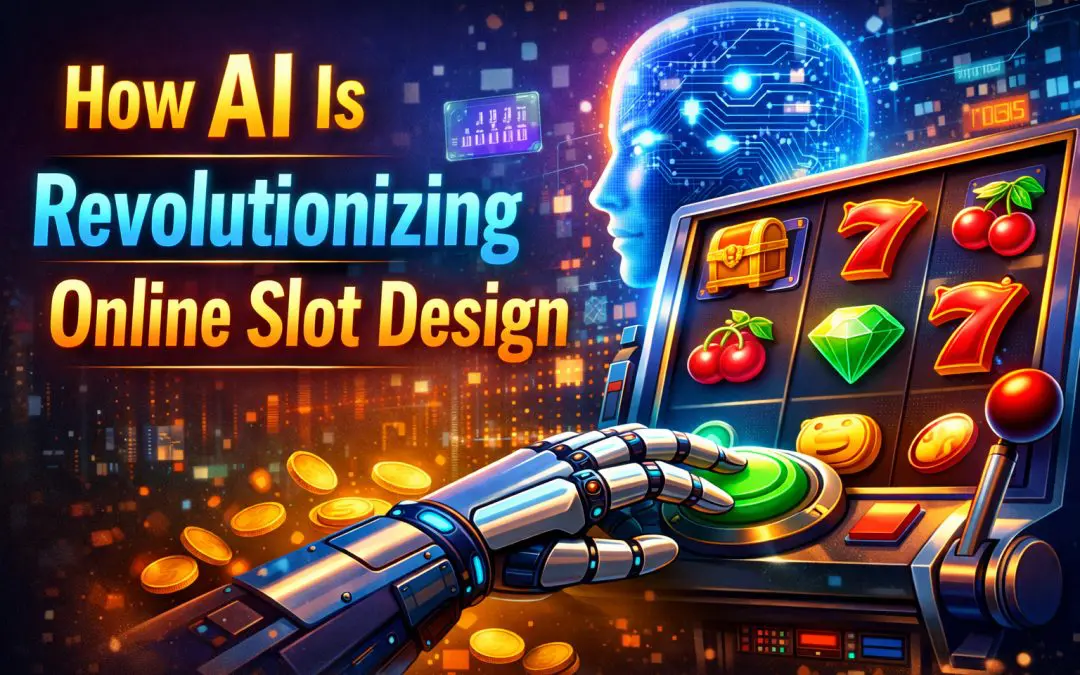
Slot machine development has always been shaped by technology; mechanical reels were replaced by video slots, static graphics were replaced by cinema-quality visuals, and so on. Yet, something has changed about the last few years. While artificial intelligence (AI) is simply another tool that developers can utilize, it is fundamentally altering how slots are created, developed, and played.
Historically, slot studios operated within the confines of static art pipelines and fixed gameplay logic. However, modern AI can generate slot game themes, pace slot gameplay, and modify slot mechanics based on real-world player behavior. As a result, today’s AI slot systems are no longer just passive tools that developers use to build slots; they are an active participant in the creative and technical slot-building process.
From generating visuals using neural networks to providing personalized gameplay based on behavioral models, AI slot design is creating new relationships between developers, players, and the games themselves.
The Emergence of AI in Online Gambling
Traditional slot development followed a well-worn path. Art teams produced slot game symbols, mathematical teams created payout curves, and development teams assembled the slot game logic. Testing teams then reviewed the slot for performance and fairness. This model worked very well for developers, but it was slow and rigid.
AI provides flexibility at every level of the development process.
Studios began using machine-learning models in the latter part of the 2010s to better understand player engagement. Initial models analyzed session lengths, bet sizes, and volatility preferences to help developers better understand what players liked most about slots.
While what developers learned surprised them, it did open the door to more extensive use of AI.
Companies such as NetEnt and MicroGaming began using data-driven tools to optimize the pacing of gameplay. Later, tools such as Unity AI tools and TensorFlow gaming frameworks allowed developers to incorporate AI more deeply into the development pipeline.
Development of slots that utilized AI did not occur suddenly. Rather, it emerged gradually as computing power improved and access to training models expanded.
Evolution of Classic Slots to AI Driven Slots
Classic slots are based on fixed logic. The random number generator (RNG) dictates outcomes, symbols appear on a static basis, and visual assets are pre-built and unchangeable.
In contrast, AI enhanced slots contain adaptive components.
Visual themes can change dynamically, music can change based on gameplay intensity, and bonus frequency can feel more responsive, although the underlying probability remains mathematically identical and compliant.
This distinction is important. AI does not replace the RNG. Compliant regulatory requirements dictate RNG usage. Rather, AI enhances everything surrounding the RNG, creating more immersive experiences without affecting the inherent fairness of the slot.
Casual players will likely not appreciate the distinction between classic and AI enhanced slots, however, the difference becomes apparent after a prolonged period of play. The slots feel less repetitive, transitions feel smoother, and the visual cohesion improves.
AI is bringing slots closer to video games than traditional slot machines.
Generative AI and the Visual Transformation of Slots
One of the most resource intensive components of developing slots is visual creation. Artists create symbols, backgrounds, animations, and UI elements. A single premium slot can take months to create.
Generative AI slots change the cost equation.
Models trained on visual datasets can generate thematic variations instantaneously. For example, a jungle themed slot could create dozens of symbol variations in minutes. Afterward, artists refine and curate the best results rather than creating all of the elements from scratch.
Systems like OpenAI DALL-E and NVIDIA Omniverse, which are influenced by various other systems, enable developers to rapidly prototype environments and test aesthetic directions without having to commit to a full-scale production effort.
The resulting productivity gains are substantial. Smaller studios can develop visually competitive slots without massive art teams.
Procedural content generation enables environments to evolve dynamically. Background elements can change slightly between spins, lighting can change based on bonus progress, and so forth. These types of changes create a sense of continuity in slots that static slots cannot replicate.
AI slot graphics also enable developers to experiment more extensively. Developers can test numerous visual styles concurrently, measure player engagement, and refine based on performance data.
The ability to iterate on slot design based on player performance creates a direct-to-player feedback loop, which greatly reduces the time required to complete a slot.
Machine Learning and Dynamic Gameplay Mechanics
Designing gameplay traditionally involved mathematical modeling and designer experience-based intuition. Designers made educated guesses regarding which mechanics would resonate with players. AI enables developers to verify those hypotheses against actual behavioral data.
Machine learning slots analyze millions of spins across various player demographics and identify patterns of engagement, i.e., how long players stay engaged with high-volatility versus low-volatility mechanics.
Using this information, developers refine features such as bonus frequency, reel timing, and symbol animations.
For example, designers found that cascading reel mechanisms gained popularity due to data showing that players preferred chain reaction mechanics over individual outcome-based spins. AI models provided additional evidence of this preference among different player demographics.
Furthermore, algorithmic reel mechanisms can optimize animation pacing. Even minor differences, such as a 50 millisecond difference in reel stop time, can influence the perceived thrill of the slot.
Studios such as Pragmatic Play and PlayTech increasingly depend on analytical-driven iteration to determine which mechanics perform best among players. Instead of guessing which mechanics will work, they measure actual player interaction.
Additionally, AI improves feature balancing. Free spin bonuses, expanding wilds, and multiplier mechanics can be optimized to enhance engagement while preserving mathematical fairness.
The end result appears to be a more polished, more responsive, and more immersive experience.
Personalization and Individual Player Experiences
Personalization is one of the most impactful applications of AI in slots.
All players have unique preferences. Some players prefer fast-paced gameplay. Others enjoy slower, more cinematic experiences. Some players prefer high-volatility slots. Others prefer more frequent smaller wins.
AI can identify these preferences and adjust the presentation elements of the slot to match the player’s preferences.
These presentation adjustments do not change the win probability. Win probability is dictated by regulatory standards and remains unchanged. The AI system optimizes the presentation.
Examples of this optimization include:
- Changing animation pacing based on the player’s interaction speed
- Providing bonus feature tutorials to inexperienced players
- Recommendation of slots that correlate with historical player engagement
- Dynamically changing music intensity during extended sessions
- Adjusting the user interface layout based on the type of device being used and the player’s behavior
These optimizations provide a more intuitive experience for players.
Increased player retention is achieved through personalized slot experiences. Players tend to gravitate towards games that align with their preferences. AI enables platforms to provide those experiences efficiently.
Increasingly, online casino technology utilizes recommendation systems similar to those employed by streaming services. Rather than recommending movies, AI recommends slot games that align with the player’s profile.
This trend promotes player engagement without modifying the fundamental probability-based structure of the slot.
Faster Prototyping and Increased Innovation
Premium slot development timelines typically range between 12 to 18 months. The introduction of AI has significantly reduced this timeframe.
Developers can generate prototype art assets immediately. Machine learning models can simulate player behavior to test mechanics prior to launch. Neural network gaming simulations enable developers to evaluate engagement potential early in the development cycle.
This accelerated development cycle has altered the creative process.
Smaller studios can now test riskier ideas without committing massive resources. Experimental mechanics can be tested quickly. Concepts that were once deemed too costly to pursue are now viable options.
The use of AI in slot design has democratized innovation. Large companies such as Evolution Gaming retain advantages related to scale, however, smaller teams can compete creatively.
Increased diversity in slots reaching the market is a positive development for players.
Enhancing Player Experience Through Intentional Design
Engagement is dependent upon emotional responses. Visual anticipation. Audio tension. Pacing of rewards.
While AI models do not directly analyze emotional responses, they can infer emotional responses indirectly through behavioral metrics. Metrics including session length, bet frequency, and interaction speed can provide insight into player engagement.
Developers utilize this data to refine experiential design.
Sound design can be adjusted dynamically. Background music may be intensified during bonus sequences. Visual effects can be scaled relative to win size.
These adjustments promote emotional coherence.
Generative AI slots also promote narrative continuity. Characters can change appearance over time. Environments can represent player progression.
These types of continuities contribute to greater immersion.
AI-driven gamification promotes progression systems comparable to those in video games. Players can earn achievements, unlock special features, and earn bonus rewards that increase long-term engagement.
Slots feel less isolated and more connected.
Improved Fairness, Compliance, and RNG Integrity
AI provides indirect improvements to fairness by improving testing and validation processes.
Random Number Generators are the foundation of slot fairness. AI enhances validation of RNG output integrity by analyzing statistical distributions across vast numbers of spins generated by the RNG.
Testing models can identify anomalies faster than traditional methodologies.
AI also enhances anti-fraud capabilities. AI can quickly identify suspicious behaviors such as bot-like activity or exploits.
Regulatory agencies benefit from these enhancements. Compliance testing is more efficient.
Blockchain slots and AI integration may further enhance transparency through immutable records and AI validation.
AI does not replace regulatory oversight. Rather, it enhances the efficiency of that oversight.
Mathematical fairness is essential to establishing player trust.
Case Studies of Major Slot Providers Utilizing AI
Leading studios have already begun incorporating AI into their development workflows.
NetEnt utilizes behavioral analytics to optimize feature pacing and player interaction design in their slots. Their slots exhibit consistently strong player engagement across varying player demographics.
MicroGaming utilizes data modeling to optimize the balance of features and volatility curves in their slots. Their progressive jackpots rely heavily on predictive analytics.
PlayTech incorporates AI-driven analytics into player recommendation systems throughout their casino platform.
Pragmatic Play utilizes automated testing systems to assess the performance of features and engagement metrics prior to launch.
These examples of AI utilization are largely transparent to players. However, they significantly improve the overall quality of the games.
Developers generally do not publicize the use of AI in their slots. Instead, they focus on producing smooth gameplay and rich visual experiences.
Players can appreciate the differences in slots whether or not they recognize why.
Ethical Concerns and Responsible AI Usage
Like all beneficial innovations, AI presents ethical concerns.
Personalization algorithms must avoid manipulative techniques. Regulatory agencies are continually monitoring the impact of AI on player engagement.
Responsible development requires transparency and fairness.
Developers must ensure that AI does not exploit vulnerable players.
There are many other forms of responsible AI development, including maintaining a clear boundary between personalization and the manipulation of probability.
Probability must remain mathematically fixed and verifiable.
Greater transparency promotes greater trust.
Regulatory agencies are increasingly evaluating AI usage during the certification process of online slot providers.
Studios must demonstrate compliance clearly.
Responsible AI development benefits both players and operators.
Future Directions: VR, AR, and Fully Adaptable Slot Worlds
The combination of AI and immersive technologies enables even more powerful utilization of AI.
 VR slots utilizing AI can create dynamic environments that respond to player behavior.
Rather than static reels, players can interact with living, breathing environments. Characters can react to the player’s actions. Environments can evolve over time.
AR slots can integrate gameplay into physical environments.
AI enables responsive environmental storytelling.
Platforms such as NVIDIA Omniverse are already capable of generating real-time environments.
As computing power continues to advance, these types of experiences will become more readily available to players.
Slot games may eventually feel more akin to interactive media than traditional slot machines.
How Developers Are Currently Using AI Internally
Most of the current internal AI usage occurs behind the scenes.
- Developers use AI for a variety of purposes:
- Analyzing player behavior to optimize engagement
- Automating visual asset generation and variation testing
- Simulating player behavior during the development process
- Automating bug detection and gameplay testing
- Creating personalized recommendations for games
These applications promote both efficiency and quality.
Players ultimately benefit from smoother, more engaging games.
Long Term Impact on Future of Online Slots
AI is transforming slot development much as video game engines revolutionized gaming approximately twenty years ago.
Slots will continue to evolve into more sophisticated interactive experiences.
Slots will improve visually at a faster rate. Slots will reduce development times. Slots will personalize the experience.
The core mathematical fairness of slots will remain unchanged. That aspect of the slot remains critical for player trust.
However, the remainder of the slot will undergo changes.
Slots will be more dynamic. More responsive. More immersive.
Players may not consciously realize every AI-driven improvement, but they can appreciate the difference through smoother gameplay, richer visuals, and greater engagement.
AI slots are not eliminating traditional design concepts. Rather, they are enhancing them.
The future direction of online slots utilizing AI involves achieving a balance between technological advancements and responsible design.
Those studios that successfully achieve that balance will define the next-generation of slot entertainment.